Armor Sandbox delivers material-accurate armored combat simulation
Simulate projectile impacts at pixel resolution: Armor Sandbox computes collision outcomes from material properties, heat, and detonation in real time. The app, from VBJ, targets simulation and military-history audiences on Android. It exposes a library of over 80 materials, more than 60 projectile types, and detailed vehicle cutaways for realistic penetration testing. Players and students who want exact, measurable results get a privacy-first, offline tool that scales physics fidelity to device performance.
What kind of simulation experience does Armor Sandbox offer?
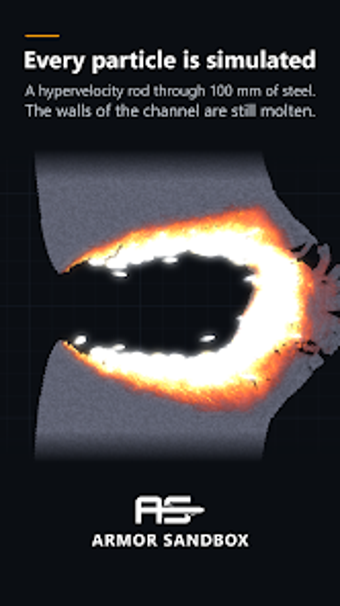
In this game, the core loop is experimental testing rather than level progression. The physics engine calculates impacts based on density, strength, and heat capacity so every collision is unique. Users pick projectiles from a set of more than 60 types, place them against pixel-accurate armor layouts, and observe outcomes such as deformation, fracture, and heat diffusion instead of scripted animations.
Does it support varied mechanics, modes, and content creation?
In this game, modes focus on sandbox experimentation and custom design. The app includes a pixel-by-pixel editor for building armor and projectile geometries, X-ray and thermal views for post-impact analysis, and detailed cutaways for over 15 tanks like the M1A2 Abrams. You can run closed, repeatable tests or open-ended scenarios with custom materials from the 80-plus library.
What does the presentation and performance feel like on mobile?
In this game, visuals prioritize data and internal state over spectacle. The interface surfaces thermal and X-ray overlays and shows particle-level damage; graphics support detailed inspection rather than cinematic effects. The physics core scales from about 18,000 to one million particles depending on device power, and the developer highlights that complex simulations take longer on older hardware.
How steep is the learning curve and what drives replayability?
In this game, the learning curve is technical: outcomes depend on material properties and impact conditions, so users need time to interpret heat maps and structural failure. Replay value comes from varying materials, projectile types, and armor geometries; the absence of scripted results means repeated tests produce different, physics-driven outcomes that encourage iterative experimentation.
Recommended for technically minded players and students
Armor Sandbox is a focused simulation for players who want measurable, material-based impact results rather than arcade combat. It suits military-history fans, engineering students, and anyone who enjoys designing experiments and comparing thermal and structural outcomes. However, its technical depth asks for patience and some prior familiarity with basic ballistics or material terms.